July 2026 · every claim verified against two independent sources; the unverified is flagged
I. The Refusal
Martin Margiela was born in Belgium in 1957 — in Genk by most accounts, in Leuven by others, including the gallery that now represents him [1][2]. It is fitting that even the birthplace resists confirmation. He trained at Antwerp's Royal Academy, cut patterns in Jean Paul Gaultier's orbit, and ran a one-season brand with the Italian pattern cutter Graziella Picozzi known only by a punctuation mark — '!' — the no-name idea in embryo [3]. In 1988 he founded the Maison with Jenny Meirens, and the refusal became the architecture: no interviews except by fax, no photographs, no bow, every communication signed 'we.' The label was a blank white rectangle held by four stitches, visible from the outside like a small surrender flag [1]. Meirens understood exactly what the blank would do: strong clothes with no name on them make people more curious. Anonymity was not shyness. It was the design statement — the argument that the garment should carry the entire burden of meaning, made at the precise moment fashion decided the designer's face was the product.
II. The Séances
The house never rented a tent. October 1988, Café de la Gare, an old Marais theater: the debut. The Tabi walked for the first time, its sole dipped in red paint so the split-toe print — not quite footprint, not quite hoofprint — was the announcement [4][5]. No European cobbler had been willing to make the shoe; the Antwerp retailer Geert Bruloot introduced Margiela to Mr. Zagato, an Italian craftsman who had produced for Tokio Kumagai and was ready to quit shoemaking. His eyes lit up over dinner [6][7]. When the season ended, Margiela cut the paint-stained runway cloth into waistcoats [5][6].
October 19, 1989: a derelict playground in the 20th arrondissement. Local schoolchildren hand-drew all five hundred invitations and sat in the front row; by the finale they were on the runway with the models [2][8]. Spring 1992: a disused métro station, the staircases lined with melting candles, and Frédéric Sanchez's soundtrack containing no music at all — twelve minutes of crowd roar spliced from live records, an audience listening to an audience [9][10]. That fall, the sales hall of the Parisian Salvation Army [11][12] — the house that rebuilt found garments, showing them where found garments are sold. These were not venues. They were arguments about who fashion is for.
III. The Argument
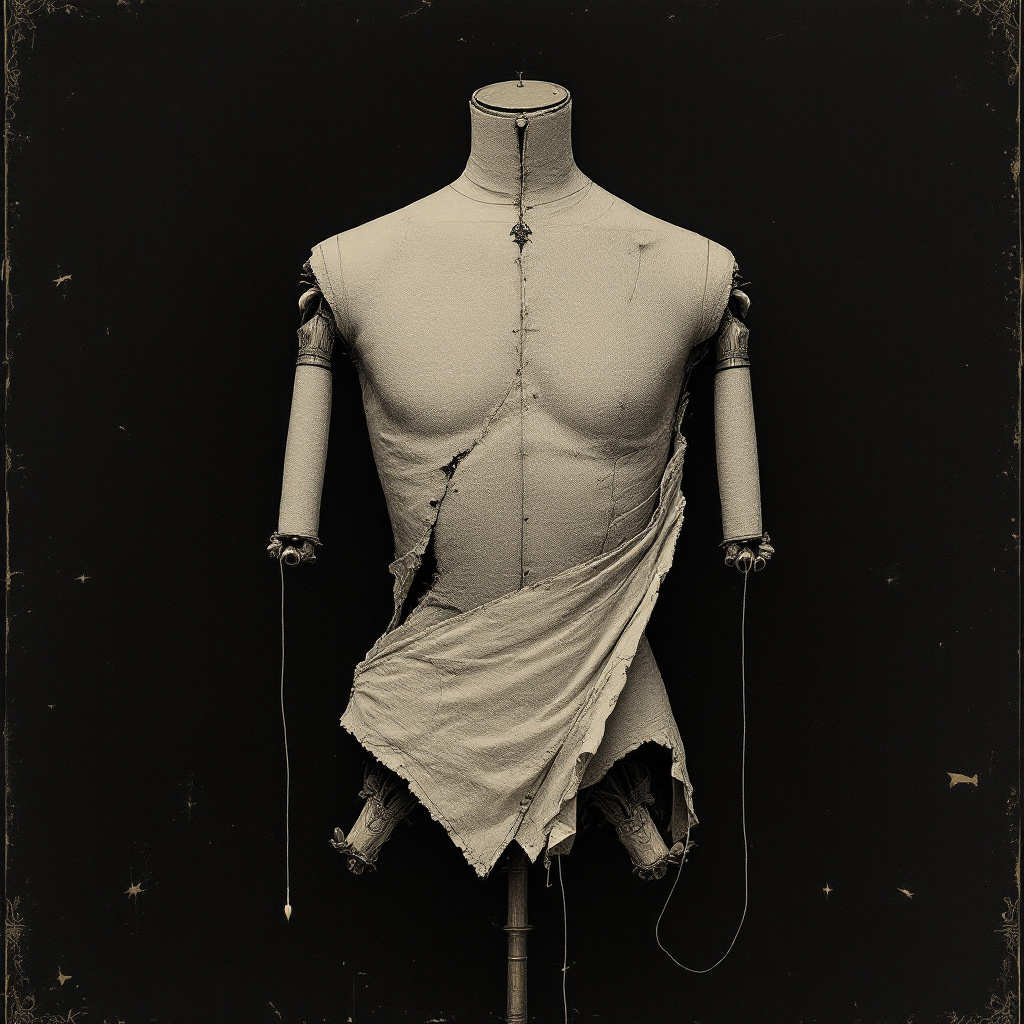
The collections interrogated the garment itself, one thesis per season. Fall 1994: clothing reproduced from a doll's wardrobe, enlarged 5.2 times to human scale with the doll's disproportions — the giant snaps, the wrong collar — kept intact; the replica and the grotesque entered the house DNA [13][14]. (Secondary sources chronically misdate this to 1990; the Met confirms FW1994–95.) Spring 1996: photographer friends shot vintage garments in black and white and the photographs were printed onto fluid fabrics — a viscose dress wearing the picture of a sequined gown, a wardrobe as an image of a wardrobe [15][16]. Spring 1997: the Stockman collection — linen mock-ups of the tailor's dummy worn as garments, stenciled 'Semi-Couture, breveté S.G.E.G. 35059,' Tabi soles taped to bare feet [17][18]. The atelier's tool became the clothes; the work was shown as the work. Spring 1998: garments engineered to lie completely flat off the body, presented on hangers by men in white coats [19]. And in 2000, la mode du XXL — everything blown up to Italian size 74/78, a size that would fit nobody yet could be worn by everybody, the knits realized by Miss Deanna's atelier [20]. Deconstruction was never destruction. It was fashion agreeing, for once, to show its arithmetic.
IV. The White
Everyone at the Maison wore the blouse blanche — the white work coat of the old couture ateliers, from interns to Martin himself, a uniform that flattened hierarchy and honored the petites mains fashion prefers to keep invisible [21]. White covered everything else too: the furniture, the boutiques, the objects. And the white was not purity — white emulsion chips, stains, and records its own wear; the house painted things white so that time would show. The same logic ran through the AIDS T-shirt of AW1994, made for the French charity AIDES: 'There is more action to be done to fight AIDS than wear this T-shirt but it's a good start,' written by Sophie Pay — Jenny Meirens' daughter — and Axel Keller, screen-printed with the shirt folded so the sentence is illegible when worn and has to be asked about. It has been reissued every season since; roughly 170,000 shirts, over €700,000 raised [22][23]. The most legible thing the house ever made was designed to start a conversation rather than finish one.
V. The Hermès Interlude
In April 1997 Jean-Louis Dumas gave womenswear at Hermès to the most anonymous radical in Paris. Margiela offered no portfolio — he gave Dumas a sequence of words: comfort, quality, timelessness, everlasting, handmade, tradition, elegance in movement [24][25]. Twelve collections followed through 2003: the vareuse neckline a woman could shrug off in one gesture, the Double Tour strap looping twice around the wrist, jumpers knitted in the round so no seam touched the skin, his friends — women from twenty-five to sixty-five — walking instead of models [24][25]. The press, which wanted the métro station and got a cardigan of impossible quality, filed it as boring. It took the 2017 MoMu retrospective for the industry to admit that the quietest work in the building had been the most radical: luxury designed entirely for the woman inside the clothes, and not at all for the row of people watching her [24]. The lesson for collectors is uncomfortable and profitable — the canon can be wrong for twenty years.
VI. The Exit
September 2002: Renzo Rosso's Only The Brave took the majority of Neuf SAS, the house's operating company [26]. Expansion followed; Artisanal became a numbered couture-calendar line; the friction between conceptual purity and commerce did what it always does. By 2008 Rosso was saying publicly that Margiela 'had not been involved in recent collections,' and Martin had quietly approached Raf Simons about taking the house — Simons stayed at Jil Sander [2]. (A parallel approach to Haider Ackermann is reported in a single trade source; we carry it as rumor [27].) The SS2009 show, the house's twentieth anniversary and fortieth womenswear collection, was a séance for itself: the first jacket reproduced, trompe-l'œil prints of its own archive, flattened jackets, enlarged finales, the models' faces veiled in stocking and hair. A birthday cake perambulated. Margiela watched from backstage and did not bow; the house categorically denied the retirement rumors [28]. On December 8, 2009, the exit was confirmed [29]. No successor was named — 'we are the Maison Martin Margiela' — and the design team carried the label until Galliano's appointment in 2014 [2][29]. He left the way he arrived: without appearing.
VII. The Ledger
The market caught up violently. In January 2025, the collection kept by Graziella Picozzi's family — four hundred pieces from 1988–94 — sold in a disused building on Boulevard Voltaire for €1,889,000, the highest total ever achieved at a fashion auction in France; a SS1990 black-and-white wool suit set the world record for the house at €101,400 [3][30]. Martin's own personal archive was announced for auction in July 2026 — until hammers fall, every figure attached to it is an estimate, not a result. For the collector, the dating discipline is the whole game: the blank four-stitch label is 1988 to early-90s; the circled 0–23 grid arrives May 1997 (a circled 10 cannot predate SS1999, a circled 14 cannot predate 2005); the care-tag code of the 2000s encodes year and season; 'Maison Margiela' without the Martin is Galliano-era, whatever the seller claims [31][32]. The era that matters runs 1988 to 2009 — and the deeper truth this ledger keeps proving is the house's own thesis: the pieces hold value precisely because the man refused to. Collect lore, not stuff.