July 2026 · every claim verified against two independent sources; community authentication lore and platform pricing flagged as such
I. The Karate Teacher
Kapital's founder came to denim through a dojo. In the 1980s Toshikiyo Hirata moved to the United States to teach and compete in karate, and there developed a fascination with American vintage denim [1][2][3]. He returned to his wife's hometown of Kojima, in Okayama Prefecture, to learn the trade [2]. The town is the context that explains everything: Kojima is Japan's denim capital, where Maruo Clothing — later renamed Big John — sewed the first Japanese-made jeans in April 1965, seeding the ecosystem that would produce Momotaro and the Japan Blue Group [13][14]. Kojima Jeans Street, the town's tourist spine, opened in 2009 — and Kapital, characteristically, does not participate [14]. The house has always sat inside the capital of Japanese denim while operating entirely outside its systems.
II. The Founding Record
The dates need keeping straight, because the sources split them: the Capital factory opened in 1984, and the brand formally launched in 1985 — both are true, one year apart [1][3][8]. The name change from 'Capital' (with a C) to 'KAPITAL' (with a K) is a genuine dispute in the record: kirikomade dates it 1996; Canoe Club says 2001 and ties it to the arrival of Toshikiyo's son Kiro as head designer — and we ship the dispute rather than resolve it silently [4][5]. One piece of common lore does resolve, against the common telling: there is no record of the Capital factory producing denim for 45rpm. The actual relationship is that Kiro Hirata worked as a designer at 45R before joining his father's company in 2002 — the rumor runs the arrow backwards [1][2].
III. The Craft Canon
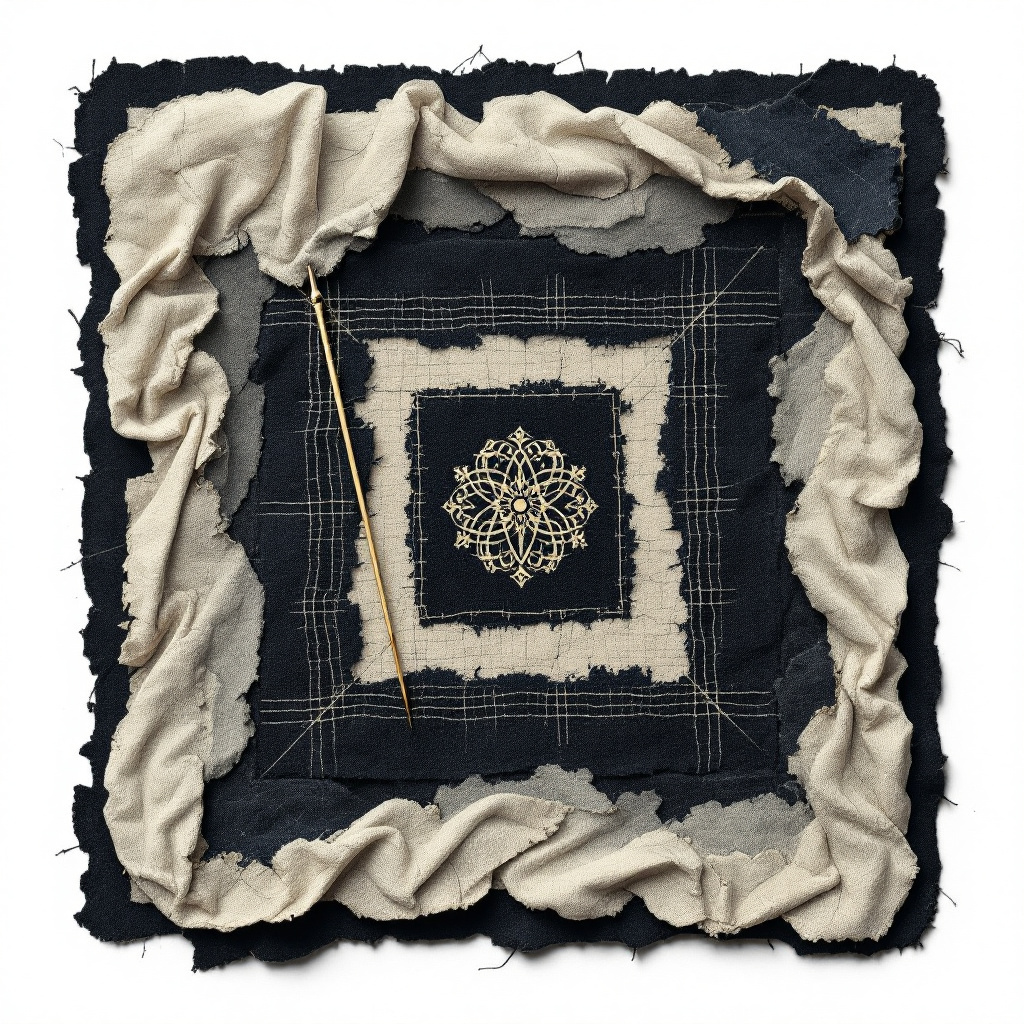
Kapital's aesthetic is built on boro — the rural Japanese practice, concentrated in the northern Tohoku region, of continuously patching and repairing textiles with recycled cotton and hemp; the ethnologist Chuzaburo Tanaka's collection, shown at Tokyo's Amuse Museum from 2009 until it closed in 2019, made the tradition famous [12]. The honest mechanics matter: Kapital does not incorporate actual vintage boro — it makes NEW fabric and treats it to meticulously reproduce the look and feel of the historical samples. It is homage, and the house's craft is precisely that reproduction [12][3]. The apex is Century Denim, launched 2012: a 12oz unsanforized denim with sashiko stitching threads woven directly into the fabric, dyed in the old vocabulary — No. 1.2.3 in layered indigo, No. 5 in kakishibu (persimmon tannin, a ruddy brown that darkens in sunlight), No. 7 in sumi (pinewood-soot ink grey), No. 9 in Amami Oshima mud [7][6]. The fabric names are the collection history, and the dye words are exactly the ones sellers abuse — the protocol page carries the definitions.
IV. The Kiro Era & KOUNTRY
Kiro Hirata left Japan around 19 to study art in the United States — which school, no non-AI source records, so we don't either — then came home to design at 45R [2][5]. In 2002 he joined his father's company, and the modern Kapital begins there: the smiley face (his homage to hippie culture) enters the vocabulary that year, and the maximal patchwork, remake logic, and Americana-through-Kojima collage that the world now knows as Kapital are the son's era [5][2]. The division of labor defined the house: Kiro drove design; Toshikiyo oversaw production and craft until his death [5][8]. In 2010 came KAPITAL KOUNTRY — the sub-label for pre-distressed, processed, and remade pieces, named after the house's finishing-and-dyeing factory in Kojima, where the washing and distressing that define the aesthetic actually happen [4][5]. The Ring Coat belongs to this era's signature rack: a structured cross between an M-65 and a peacoat with a triple button placket — not the 'blanket coat' of listing lore [5].
V. The Scene & the One Co-Sign
Kapital operates outside the fashion system it quietly feeds. No runway calendar — the seasons are elaborate named lookbooks shot everywhere from South Africa to Iceland [2]. Distribution stayed tightly held: fifteen-plus brick-and-mortar stores in Japan, roughly sixty international stockists, a web shop existing by 2019 [2]. And in a canon built on collaboration, Kapital barely collaborates — which makes the one institutional co-sign enormous: for Louis Vuitton Spring/Summer 2013, Kim Jones enlisted Kiro Hirata to create genuine Japanese boro denim pieces for the house — Kapital's techniques on luxury's biggest stage, years before the brand's Western cult formed [15]. The coda came in January 2025: 'GUIDING LIGHT,' a runway-format show premiered online — a formal departure from the lookbooks, conceived by Kiro as a tribute to his late father. 'The runway show is our farewell,' he said. The house's first runway was a eulogy [16].
VI. The Ledger
The market runs on community consensus — no major-auction record exists for Kapital, and we say so plainly. Platform reality at research time: the Katsuragi Ring Coat trades $349–650 on Grailed; a Century Denim 1st Jkt sold at $480; complex KOUNTRY boro pieces ask $2,200 and up [5][6]. The structural fact is the gap: pieces on Yahoo Auctions Japan and Mercari Japan trade substantially below Western platforms (community consensus — no precise figures exist), which is why the proxy-service collector lane matters and why the landed-cost math decides whether the arbitrage is real [18]. The ownership coda: Toshikiyo Hirata died in April 2024, at 75 [8][9]. Within the year, L Catterton — the LVMH-associated private-equity firm — quietly acquired a majority stake, reported publicly in January 2025, with Kiro continuing as creative director [10][11]. The karate teacher's factory is now in luxury's orbit; whether the craft survives the capital is the question every collector is pricing.
VII. The Authentication Layer
Kapital is notoriously difficult to authenticate, and the reason is structural: no published cipher exists for product codes or label dating — the absence itself is the protocol [17]. What the record supports: the 'Capital' (C) to 'KAPITAL' (K) label transition marks the rough pre-modern boundary (year disputed, 1996 vs 2001), and everything else is provenance and construction [4][5]. The counterfeit market is highly active, worst on Yahoo Auctions Japan and Mercari Japan; the most-faked pieces are the smiley knits and the boro work [17]. The house's real signature is the hardest thing to fake — the intricate dyeing and distressing processes of the KOUNTRY factory — so condition-inconsistent 'aging,' flat-looking patchwork, and dye work without depth are the practical tells (community-sourced, flagged as such) [17]. Two seller-lore corrections to carry: 'vintage boro incorporated' is wrong (the boro is reproduced on new fabric), and '45rpm-manufacturer provenance' is a fabrication — the 45R link is Kiro's design years, not a contract [12][1][2]. When in doubt: buy the seller, not the tag — there is no tag to buy.