July 2026 · every claim verified against two independent sources; the rumored is flagged as such
I. The Autodidact
He was born Peter Scepka in Vienna on 10 March 1956, and renamed himself — Helmut, his third given name, and Lang, the surname of the grandparents who raised him after his parents split when he was five months old [1][2]. They raised him in Ramsau am Dachstein, high in the Austrian Alps, and his grandfather the shoemaker taught him the only thing that ever really governed his work: 'work is a process that takes as long as necessary, until one is satisfied and proud of the results' [4]. He had no training. 'I had no formal training in fashion, and I have no formal training in art,' he said. 'Consequently, I am creating my own language by being unafraid and experimenting the hell out of things' [4]. He opened a made-to-measure studio in Vienna in 1977, at twenty-one, and a boutique two years later [5][3]. In 1986 his work was shown in Paris for the first time — off the fashion calendar, inside the Centre Pompidou's exhibition 'L'Apocalypse Joyeuse,' initiated by the Austrian government [1][2]. The man who would industrialize minimalism arrived through an art museum, not a runway. He never fully left the museum.
II. The Anti-Spectacle
In 1988, in Paris, Lang refused the runway. He called his shows séances de travail — working sessions — and staged them as exactly that: models wandering a working space in pairs, no down-and-back catwalk, seats lining all four walls, the cast filled out with friends and non-models [7][5]. Simon Doonan said he cast them 'like a Fassbinder movie.' This was a position, not a style. The 1990s belonged to two theatres at once — Galliano's opera at Dior, McQueen's cruelty in Spitalfields — and Lang proposed the precise opposite: not fashion as spectacle but clothes as reality, the garment stripped of narrative until only the fact of it remained [2][6]. He was the argument that restraint could be the loudest thing in the room. The whole minimalist cult that collects him now is really collecting that argument — the belief that what you take away matters more than what you add.
III. The Vocabulary Everyone Speaks Now
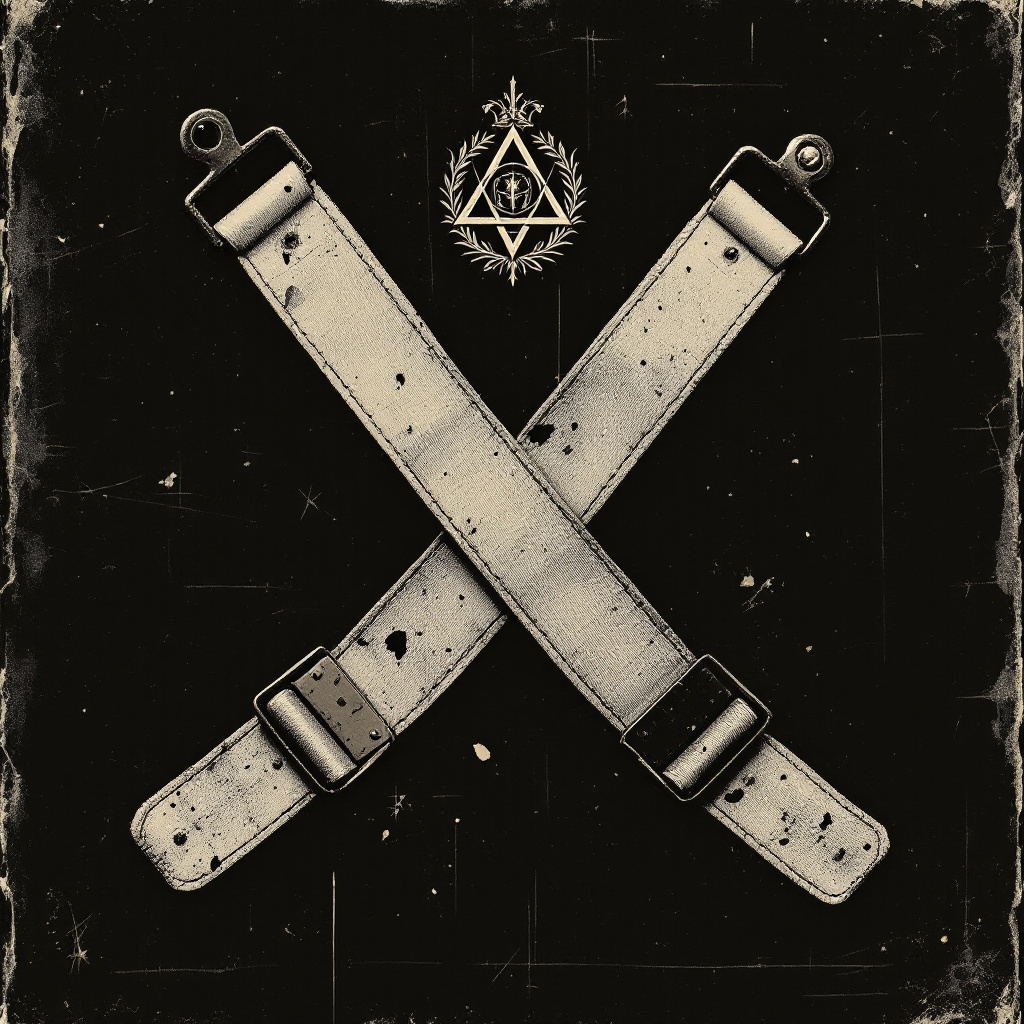
Look at how a fashionable person dresses today and most of it is Lang's, unattributed. He industrialized 'techno' fabrics — nylon backed with silk, metal-blended textiles — and the interior bondage/harness strap, so a coat could be shrugged onto the back like a pack [6][2]. He made transparency and mesh wearable; cut the flat-front trouser as a rebuke to Armani's pleats; raised the armhole into a signature; and elevated the uniform — police gear, the bulletproof-vest silhouette, workwear — into intelligent luxury [6][2]. And he made denim a designer object: he priced raw jeans near $200 when nobody dared, and to many he 'pioneered the then-nascent designer denim market' [2][6]. The Painter Jean — rubber-based paint that survives the wash — was introduced for his SS1998 menswear and became the definitive splatter denim by SS1999; McQueen himself was photographed in a pair [27][2]. None of it announced itself. That is exactly why it spread everywhere: a vocabulary invisible enough to become the language.
IV. The Calendar Break
In April 1998 his show venue fell through four weeks out, and Lang did something nobody had done: he distributed the Fall 1998 collection — eighty-one looks, on models including Kirsten Owen and Tatjana Patitz — on CD-ROM and posted it to helmutlangny.com, with roughly a thousand taxi-tops driving traffic to the site — the first designer to show a collection on the internet, a full decade before the industry followed [7][8]. Anna Wintour called the CD-ROM 'a huge mistake'; Lang called it 'a shock to the system, but a beginning of the new normal' — and, by his own later account, the intention was never to be first: the digital show protected the intimate 'séance de travail' format from a hype that had become overwhelming [2][8]. He repeated the online-only format once more, after September 11, 2001 — the second digital show almost nobody remembers [8]. Then, that July, he broke the calendar itself: he announced he would show Spring 1999 in New York ahead of the European collections, permanently moving New York Fashion Week to the front of the season. Calvin Klein followed the next day; Pierre Bergé accused him of 'inciting anarchy' [3][5]. And the advertising was its own rupture — the first fashion house on New York taxi roofs, 1998 to 2004, the copy reading 'Impress Your Parents, Wear Helmut Lang,' the imagery built from Robert Mapplethorpe's and David Sims's photographs rather than a product shot [22][1]. He understood the medium was the message before the phrase reached fashion.
V. The Art Axis
Lang's universe ran on an art axis, not a fashion one, and its center was the conceptual artist Jenny Holzer. Their collaboration began at the 1996 Florence Biennale — on the critic Ingrid Sischy's suggestion — with 'I Smell You on My Clothes,' Lang pumping in the scent a lover leaves on sheets while Holzer's LED signs flashed possessive proclamations [9][10]. When he built the SoHo flagship at 80 Greene Street in 1997, the architect Richard Gluckman gave it a street-facing reception room holding no merchandise at all, with a Holzer LED column where the product should have been [12][23]. And the 2000 fragrance campaign — art-directed by Marc Atlan — was pure anti-advertising: Holzer's stark text ('I BITE YOUR LIP / I BREATHE YOUR BREATH') on plain white, no product, no logo [9][11]. His other close friend was Louise Bourgeois; the three of them shared a 1998 exhibition at Kunsthalle Wien on the body, skin, and 'the protective surfaces of vestimentary codes' [13]. Bourgeois gave him more than a show. She gave him the sentence that would end the whole thing.
VI. The Fire
The corporate story is quick and sad. Prada took 51% of the company in 1999 — revenues then near $100 million, denim more than half of them — and the rest in autumn 2004; when the machine cut the denim line, revenue collapsed toward $30 million [15][6]. In January 2005, after mounting tension with Prada's Patrizio Bertelli over control, Lang resigned and walked out of fashion entirely to become a visual artist; Prada sold the trademark to Tokyo's Link Theory, a Fast Retailing company, in March 2006 [16][17]. Then the myth was sealed by fire. In February 2010 a blaze tore through the building housing his New York studio. Lang donated the surviving pieces to some eighteen to twenty museums — then put roughly 6,000 incinerated garments through an industrial shredder under his own supervision, twenty-five years of work turned to pigment and resin for the 2011 'Make It Hard' sculptures, citing Bourgeois: 'materials are just materials, they are here to serve you' [23][14]. Only the MAK in Vienna holds the official Helmut Lang Archive of 1986–2005 now — some 9,000 records, over 1,400 garments [14]. Everything else in private hands is finite, and shrinking. He did not just leave. He made sure there would be less of him every year.
VII. The Ledger
This is an identification cult, and the dating is the entire game. Japanese collectors named the era first: 本人期, honnin-ki, 'the person's own era' — the tag that marks pre-2005 Lang across the Japanese resale market, where the dating skill is a documented discipline [28]. The tells are precise. 'Made in Italy' is the personal-period marker; after his departure production moved to 'Made in China' or 'USA,' and a China tag on a claimed 90s piece is a flag — corroborate with the GIBO (mainline) and GTR (jeans) Italian factory tags [18][19]. Ignore the label-color folklore: black-versus-white matches the garment, not the year [20]. The fit runs small — 'when in doubt, size up' [21]. And never pay archive money for a 2017-plus 'Re-Edition,' which is a marked reproduction, not a personal-period piece [18]. The market has a keeper — Michael Kardamakis's ENDYMA in Athens, the world's largest private collection and the reference library that dates the rest of us [25]. The apex object is the AW1999 Astro Biker, moto leather and ballistic nylon, asking $850 and up [24]; the sleeper is the tailoring, the suits that 'look like boxes online' and hide masterful shoulders [21]. In January 2025 an ENDYMA auction reportedly cleared over €100,000 for a single polka-dot wool suit — twenty-eight times its estimate, and, for now, a rumor from one video rather than an auction-house result [26]. Verified or not, it points one way: the man who shredded himself into scarcity is being repriced as art. Collect the honnin-ki era, at the object the market hasn't finished reading. Collect lore, not stuff.